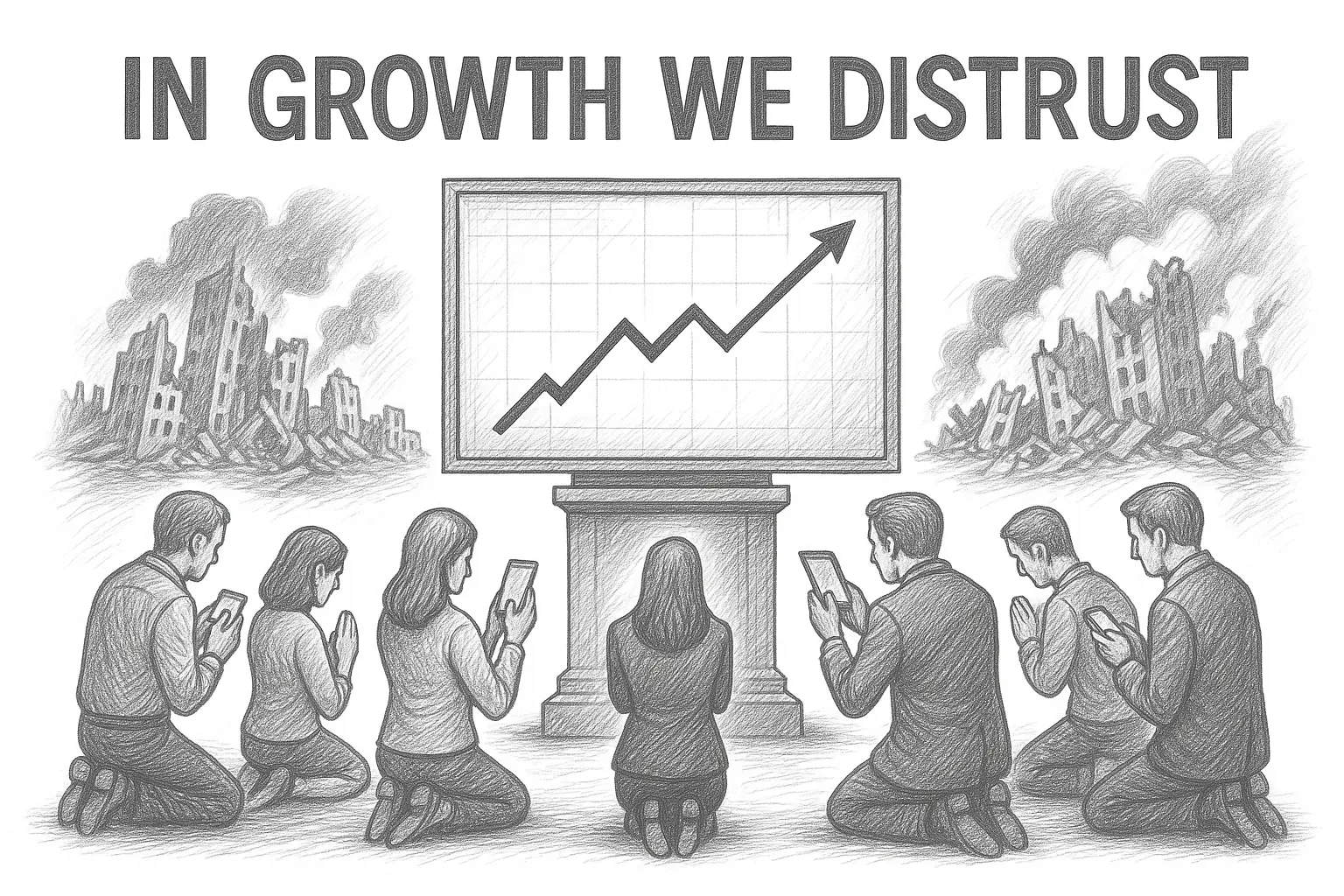
When profit becomes the purpose, purpose disappears.
---
Hey, long-game thinkers —
If you ever met someone who says “I’m doing this for the money,”you can already predict how the story ends: stress, burnout, mediocrity, and unconvincing posts about “mental health in leadership.”
Here’s the ugly truth of modern business: money is not a strategy.
It’s a receipt.
It’s what the world gives you back when your ideas, your ethics, and your timing make sense together. When they don’t, money just keeps score of your exhaustion. The question that matters isn’t “How do we get more revenue?”
but
“What do we do so well, for so long, that revenue can’t help but follow?”
---
The Illusion of Performance
Modern capitalism confuses effort with effectiveness.
We glorify the founder who sleeps under the desk, the team that “hustles harder,” the startup that ships fifteen features nobody asked for.
It’s the cult of output — an arms race of activity where hours are the currency and busywork is the costume of ambition.
Yet markets don’t reward exhaustion; they reward alignment.
Research from Harvard Business Review shows that companies with clearly articulated missions outperform peers by up to 42% in long-term revenue growth.
The companies that endure — Patagonia, LEGO, Ferrari, even IKEA — didn’t start with profit targets. They started with an obsession: make the best mountain gear and protect the planet; turn creativity into play; turn precision into emotion; make design democratic and human.
They built operating systems where money follows meaning, not the other way around. The performance trap is seductive because it produces graphs. Alignment is harder because it requires taste, patience, and the courage to say no.
Emotional Capitalism (The Only Kind That Compounds)
Call it what it is: emotional capitalism—
a system where energy and authenticity compound faster than capital, where vision scales harder than performance metrics, and where belief — not budget — builds momentum.
When you operate from shared purpose, you unlock something economists can’t model: voluntary excellence.
Gallup data shows that highly engaged teams deliver 21% greater profitability, not because they work harder but because they care. That’s the force that turns customers into evangelists, employees into co-founders, and products into movements.
Consider LEGO: after nearly imploding in the early 2000s by chasing every adjacency, the company refocused on its core promise — “inspire and develop the builders of tomorrow.”
Cutting noise, it rebuilt culture and returned to a multi‑billion platform anchored in joy rather than spreadsheets.
Or Ferrari: it doesn’t compete on units sold; it competes on soul per engine. The stock is resilient because the identity is sacred — every car is a belief system on wheels.
Or Patagonia: when Yvon Chouinard transferred ownership to a trust aimed at fighting climate change, many called it radical; in reality, it was accounting catching up with philosophy.
Values had always been the profit center — the balance sheet simply stopped pretending otherwise.
Burnout Economics vs Belief Economics
The burnout economy chants: “Do more, faster.”
The belief economy counters: “Mean it, and it will scale.”
In practice, consistency beats speed and conviction outperforms noise. Build on meaning and you accumulate trust— the only asset that compounds across cycles.
Build on greed and you inherit a treadmill — louder, faster, emptier.
Short‑term performance is a sugar high; purpose is metabolic health. A Deloitte study found that purpose-driven companies grow three times faster than competitors and retain employees 40% longer. The modern obsession with optimization — more hours, more output, more dashboards — creates founders who burn twice as bright and half as long.
The irony: companies that slow down to protect coherence often grow faster, because belief is conserved as fuel rather than consumed as fireworks.
Case Studies in Forgetting
When firms forget the cause‑and‑effect, they reverse it — and the market eventually corrects the delusion. WeWork promised community and sold real estate; valuation replaced validation and gravity did the rest.
FTXleveraged charisma as collateral until ethics presented the bill. A constellation of “AI‑for‑everything” startups confuses virality with viability, shipping demos in place of discipline.
McKinsey research on startup mortality shows that over 70% of high-growth ventures fail not from lack of funding but from strategic incoherence — scaling without soul. Optimizing for exit instead of existence produces a single result: fragility.
The crash is not only financial; it’s moral — teams lose faith, customers lose trust, and the brand loses the right to be believed.
The most sustainable profit is the kind you didn’t optimize for. Purpose‑driven companies don’t fight gravity; they use it. The flywheel is simple and stubborn: vision attracts talent; talent builds culture; culture compounds trust; and trust monetizes itself.
When that flywheel turns, spreadsheets stop being roadmaps and become mirrors. By the time accounting notices, the business is already self‑propelling. A 2024 PwC report found that brands perceived as “purpose-led” outperform the market by 134% in shareholder returns over ten years.
Revenue becomes a consequence of coherence, not a consolation prize for burnout. The right metric for leaders is not “hours invested” but “belief preserved.”
Maybe the real post‑capitalist rebellion isn’t redistribution — it’s sincerity at scale. Doing things so well, for so longthat money becomes a byproduct, not the banner.
The market doesn’t care how many hours you worked; it cares whether anyone gives a damn about what you made and whether you’ll still be around to stand behind it.
So stop sprinting toward revenue and start orbiting around meaning. The companies that believe are the only ones people never get tired of paying.
Until next time — build slow, mean it, and watch profit chase you for a change.
Alex